
Background and objectives
The energy and digital transitions rely on a growing demand for mineral raw materials, both in terms of volume and diversity. This situation presents Europe with major strategic challenges in securing its supply, as reflected in the adoption of the European Critical Raw Materials Act (CRMA). Yet the issues surrounding raw materials, and their connection to everyday objects, remain largely unknown to the general public. This limits citizens' ability to take part in future decisions and trade-offs on an informed basis.
This lack of awareness goes hand in hand with declining interest in geoscience education and training: undergraduate enrolments fell by 15% between 2019 and 2023 (source: Le Monde, 28 May 2024). While this trend can partly be explained by reforms to the general education system, geosciences also suffer from a lack of visibility of their own. This is linked to negative stereotypes associated with extractive industries, competition from more widely publicised fields of study, and a lack of recognition of the subsurface as a shared resource that must be managed sustainably.
As a result, secondary school students and teachers have limited awareness of the role geosciences play in securing drinking water supplies, preventing natural hazards, developing geothermal energy and identifying the mineral resources needed for the low-carbon transition.
Against this backdrop, SensMaTer aims to lay the foundations for a lasting shift in how the subsurface is perceived: from a scientific subject often seen as complex and disconnected from everyday life to an issue of genuine societal importance. The project seeks to foster a shared understanding between researchers and citizens, while helping to train a new generation of professionals who view the subsurface as a common heritage.
To achieve this, the project combines awareness-raising activities — sharing scientific knowledge within cultural, historical and landscape-related contexts, sometimes through artistic interventions — with training initiatives targeting secondary school students and teachers. These activities will be piloted in a range of contrasting territories: urban, rural, industrial and natural environments.
Four complementary projects
The Metals Mural and the 10 Tonnes Workshop
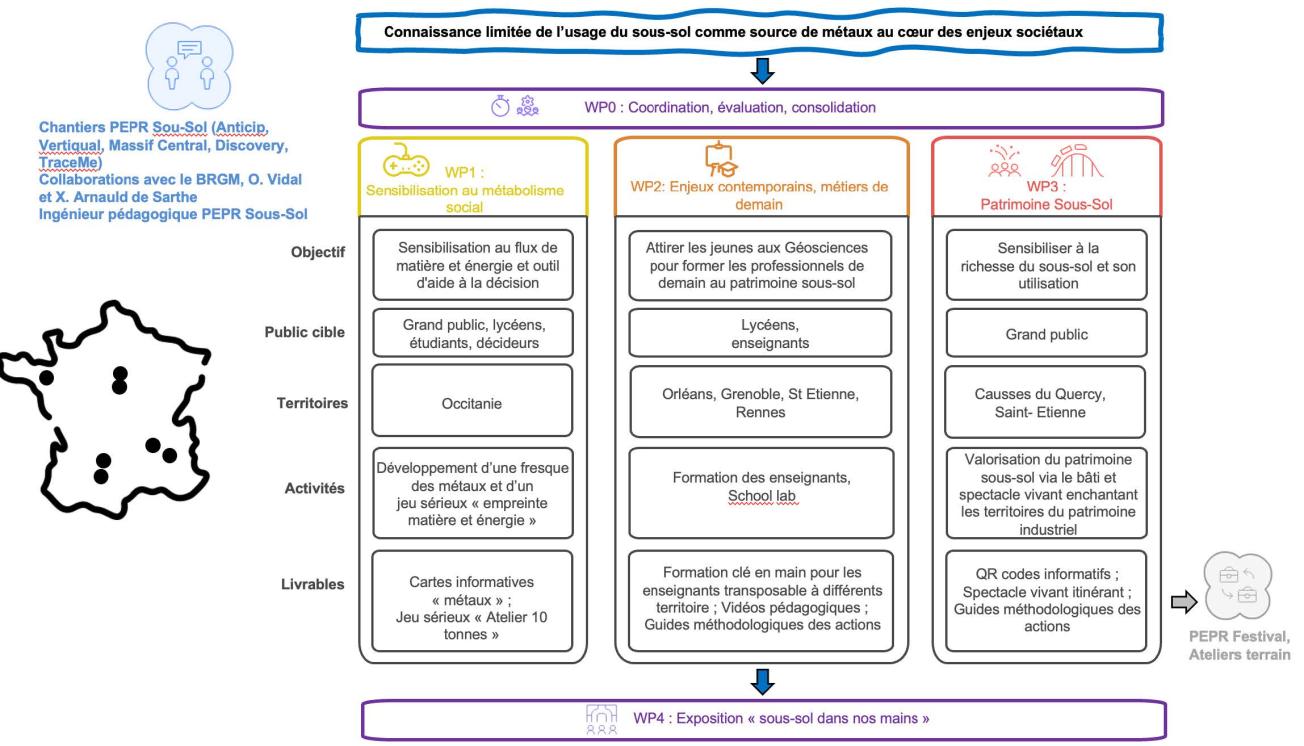
This first initiative offers two participatory tools designed to raise awareness of material and energy flows within the social metabolism. They are intended for a wide range of audiences, including the general public, school students, industry professionals and decision-makers.
The Metals Mural, inspired by the Climate Fresk, uses informative cards to explore the life cycle of metals, from the geology of mineral deposits to recycling, including their uses and environmental impacts.
The 10 Tonnes Workshop, modelled on the 2 Tonnes Workshop, which focuses on carbon footprints, will build on the same set of cards. Participants will calculate their own material and energy footprint based on the choices they make when exploring different energy transition scenarios. The initiative is ultimately intended to be rolled out nationwide.
The Subsurface: A Contemporary Challenge and Careers for the Future
This second project aims to inspire young people to pursue careers in geosciences, with a particular focus on encouraging more young women to enter the field. It comprises two complementary strands:
A two-day training course for secondary school teachers, designed to break down disciplinary boundaries between subjects such as life and Earth sciences, physics and chemistry, economics and social sciences, history and geography, and philosophy. It will initially be rolled out in the Orléans-Tours education authority (Académie d'Orléans-Tours), before expanding to Grenoble and Rennes.
A SchooLab, run in partnership with CCSTI La Rotonde, which connects secondary school classes with the professional realities of working in the subsurface through year-long collaborative projects. Students will present their work in a format of their choice, such as a television news programme, exhibition, comic strip or radio show.
Subsurface Heritage
This project aims to bring geology, landscapes, industry and heritage into dialogue.
It will take the form of a travelling live performance developed following an artist residency at two pilot sites with contrasting histories: the Causses du Quercy Regional Natural Park and UNESCO Global Geopark, shaped by the historic mining of phosphate deposits, and the Saint-Étienne coal basin, whose landscapes have been transformed by coal mining and its spoil heaps.
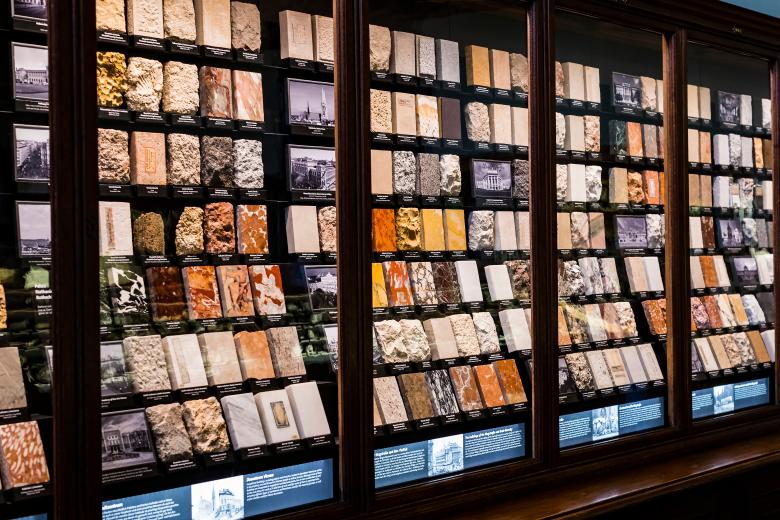
The project will also involve installing informative QR codes at three historic monuments in Paris. Developed in partnership with the Historical Monuments Research Laboratory, these will reveal the geological origins of the building materials used in the French capital.
Travelling exhibition: "The Subsurface in Our Hands"
This project aims to bring together the outputs of the other three initiatives in a travelling exhibition for the general public, with a particular focus on lower and upper secondary school students.
The exhibition will be organised into six stages, each exploring an iconic everyday object: the smartphone. It will examine the geological resources needed to manufacture it, its impacts and the sustainable alternatives that could be considered.
The exhibition will first be tested in Grenoble, where the Observatory of Sciences of the Universe (OSUG) already has a public exhibition space. It will then be rolled out to other territories and networks, including libraries, science and technology centres (CCSTI) and associations.
Organisation du projet
Organisation du projet SensMaTerre
projet SensMaTerre
Project lead
Carole Cordier (Université Grenoble Alpes), Associate Professor, ISTerre Laboratory
Partners