
Project background and objectives
In line with the COP21 commitment to limit global temperature rise to 1.5°C above pre-industrial levels, France has adopted the “Stratégie Nationale Bas Carbone,” which aims to reduce energy consumption, while also promoting the development of renewable energy sources. This objective raises important questions about the potential of underexplored energy resources, such as natural hydrogen and geothermal energy which rely on the extraction of subsurface materials. Ensuring the societal acceptability of exploiting these resources requires intensified and accelerated efforts to better understand their generation, potential for storage, and overall viability.
Using the energy resources in sedimentary basins and igneous and metamorphic basement rocks, such as natural hydrogen or geothermal energy, is key component of the energy transition. In this regard, the thermal structure of the lithosphere is a fundamental, yet poorly constrained, component of reservoir models, particularly for geothermal exploration or the formation of gases such as natural hydrogen.
Reservoir models of current resources use short-term and often transient thermal-hydraulic model types calibrated using parameters such as geothermal gradients, heat flow and thermal properties measured in-situ close to the surface. They assume conduction of heat or convection driven by fluid movements (e.g. thermal anomalies across faults), gas solubility crucial for natural hydrogen or stress states.
These fundamental parameters, while valid in the short term may not be valid in the long term. This scaling issue is particularly critical in case of natural hydrogen exploration. Indeed, it is not yet clear whether the measured fluxes (e.g. Aquitaine Basin) reflect active processes that can be modelled with this type of approach, or whether they indicate transient accumulations that require knowledge of the geological history, and therefore the generation, migration pathways of fossil fluids, and trapping of H2 over millions of years. Moreover, because the generation of H2 is often the result of chemical reactions between deep hydrothermal fluids and rocks, e.g. serpentinization or other HT alteration processes, a prerequisite is understanding how heat and fluids are transferred from the mantle to the shallow reservoirs in sedimentary basins and its basement at present, which is the result of long-term dynamics over tectonic cycles.
Expected outcomes
The IDYLLE project seeks to bridge the gap between lithosphere-scale processes and the origin and transfer of heat, gas and fluids stored in shallow crustal reservoirs. The proposal focusses on enhancing the current reservoir modelling to more accurately assess the potential for natural hydrogen and geothermal energy.
To tackle the difficult problem of heat and fluid transfer over short/long time and spatial scales, the novelty of IDYLLE is to gather on a single platform a unique research team (24 researchers and 7 postdocs) that has complementary expertise in the field of tectonics and geodynamics (field-based geology, numerical modelling, fluid-rock interactions, magmatic petrology and noble gas geochemistry), basin evolution (stratigraphy, sedimentology, coupled surface-tectonic modelling) and reservoir geochemistry and modelling (simulation of gas production and fluid/gas migration).
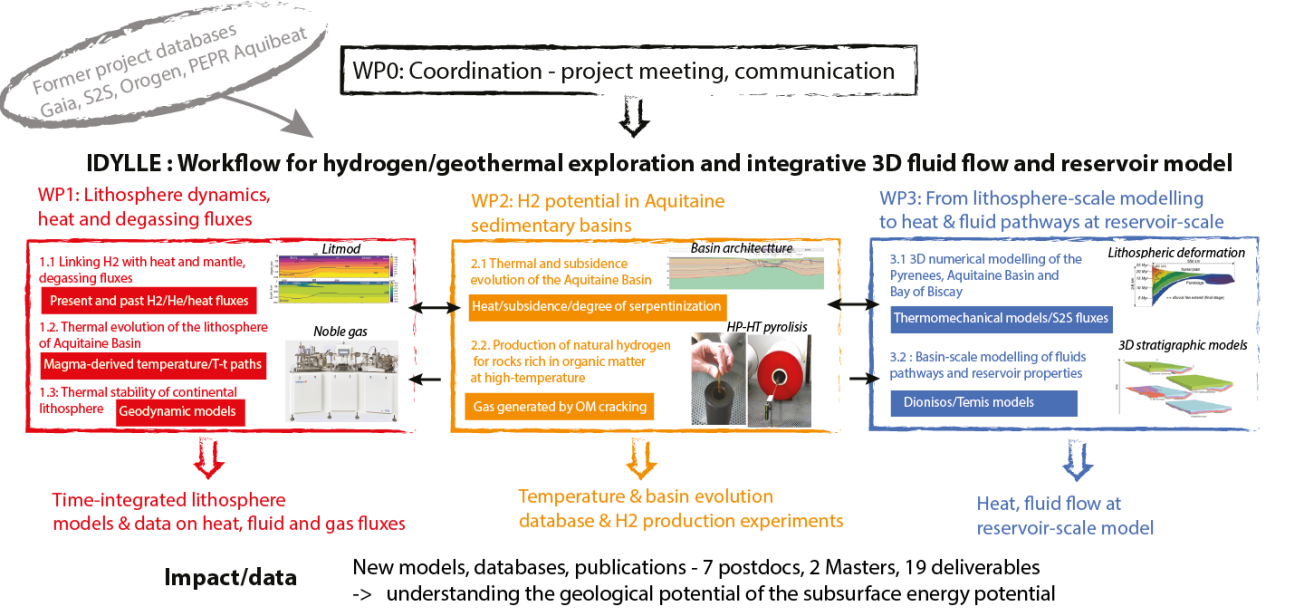
IDYLLE will aim at :
- collecting data on heat, fluid, and mantle degassing fluxes (WP1);
- analysis of thermal events, subsidence, and H₂ generation (WP2);
- the development of 3D sedimentary basin models integrating these data and the one from PCs to restore sedimentary architectures and fluid migrations through time and model the resulting distributions of heat and H2 fluxes and reservoirs properties at basin scale.
Among the many scientific and applied deliverables of IDYLLE are:
- A comprehensive database of present-day and fossil fluid pathways, temperature and degassing and heat fluxes at the lithosphere scale in the Aquitaine Basin;
- Calibration of fossil H2 fluxes based on a combination of experimental data and reservoir models enabling us to potential for H2 to be trapped in the Aquitaine Basin;
- New modelling approach using cross-validation and downscaling between convection models, petro-physical characteristic of the continental lithosphere and basin and reservoir modelling at the scale of the Aquitaine basin with the goal to assess the geological potential for natural hydrogen.
IDYLLE will deliver new data workflows to characterize, the heat and gas fluxes at the scale of France, that are first order contributions for exploration estimation of subsurface resources potential in the energy transition. Aquitaine basin scale model of gas and geothermal potential will drive future more detailed explorations. The compiled model of the reservoir of the Aquitaine basin will also be significant contribution for other uses of subsurface such as C02 storage.
Organisation du projet
Présentation scientifique
Project leader
Frédéric Mouthereau (Université de Toulouse), IDYLLE and WP1 project leader

Frédéric Mouthereau
Frédéric Mouthereau
Frédéric Mouthereau is a professor at the University of Toulouse (Géosciences Environnement Toulouse laboratory) and a senior member of the Institut Universitaire de France. He holds a PhD from Pierre and Marie Curie University (Sorbonne University). His research focuses on the coupling between continental lithospheric deformation and surface processes associated with mountain building and, more broadly, the evolution of continental topography. He combines field-based approaches, thermochronology, geochemistry, and geophysics, with societal applications related to geological hazards and the energy transition. He has led and co-led numerous national and international projects (ANR, CNRS–industry), published around 100 scientific articles, supervised 19 PhD students, and held major responsibilities in training and fostering the international scientific community. He is the coordinator of the IDYLLE project and leader of WP1.
Partners