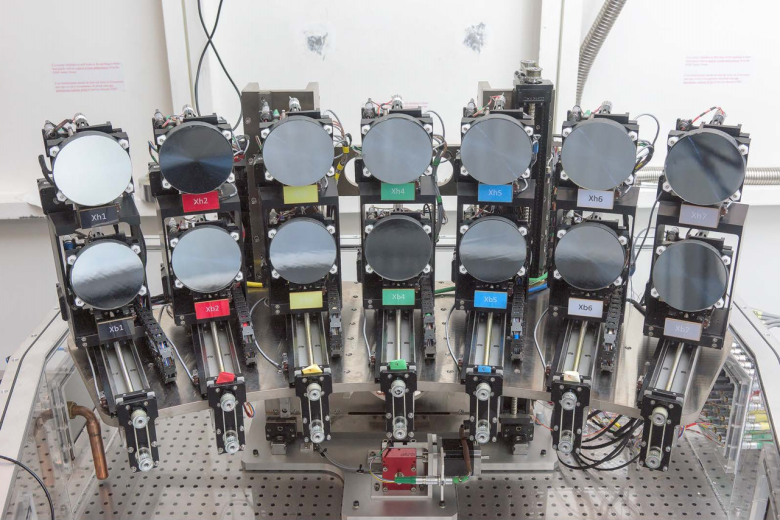
FAME-UHD analyzer crystals for high-resolution in situ spectroscopy.
© Denis Testemale (INEEL).
Project background and objectives
The major societal challenges, such as population growth, climate change, and energy transition, generate unprecedented demand for different metals. However, recycling alone will not be able to meet the rapidly growing needs for strategic metals. It is therefore essential both to better manage and renew their currently known mineral resources. The most striking feature of the natural resources of these metals is their ubiquitous association with sedimentary rocks rich in organic carbon (Corg). However, the links between metals and Corg remain a great enigma.
- What is the nature of metal-Corg associations: chance or symbiosis?
- Does organic carbon play a role as source, transport, or trap?
- Could the presence of Corg be a marker of metal accumulation in rocks?
- How to extract metals from ores and wastes rich in Corg?
Answering these questions will enable a leap forward in exploration and ensure more sustainable management of potential critical metal resources in the French subsoil and globally.
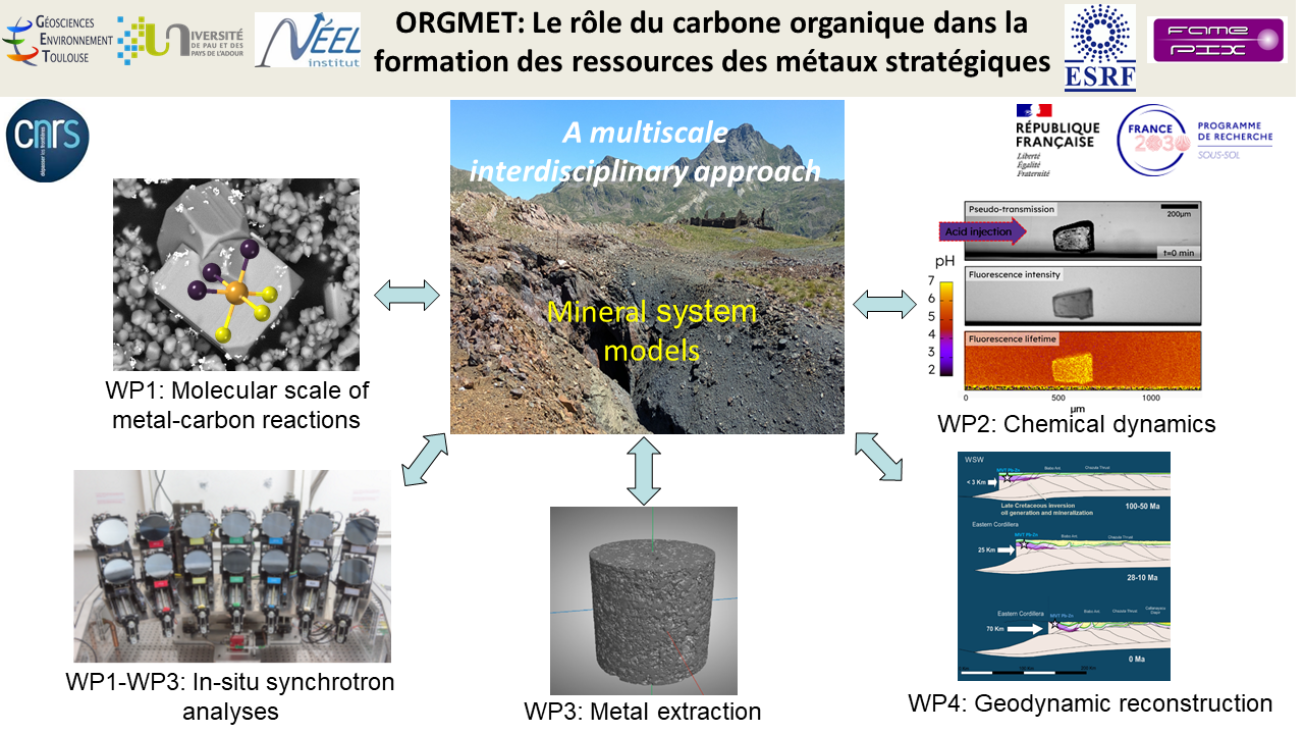
These answers require a synergy of approaches at the interface between geosciences, physics, and chemistry, applicable across a very wide range of scales, from the molecule to the metallogenic province.
A consortium of 4 French laboratories will develop such a new methodology to:
- simulate reactions between hydrothermal fluid, Corg, and metals in the laboratory using chemical reactor methods coupled with in-situ spectroscopy and imaging at synchrotron;
- characterize the 3D properties of metal- and carbon-bearing fluids in porous media;
- optimize leaching protocols for critical metals for rocks rich in organic matter;
- reassess certain key sediment-hosted deposits in the Pyrenees ‒ the region that represents significant potential for strategic metals in the French subsoil.
Expected outcomes
This project aims to apprehend, for the first time, the true role of organic carbon in the formation and distribution of strategic metal concentrations in the Earth's crust and to propose multi-scale physico-chemical, geochemical, and geodynamic criteria, based on metal-organic carbon links, in order to assess future metallic resources in France.
Complementary to the targeted Aquitaine Basin and Massif Central projects, ORGMET will enable reassessment of Pyrenean deposits in sedimentary rock where organic matter intervenes in the mineral system (source, transport, trap, preservation). This approach will be coupled with multi-scale modeling of fluid-rock-Corg interactions, to identify new environments of potentially exploitable metal concentrations on French territory.
This project federates a broad French community of geologists, chemists, and physicists around one of the greatest challenges of our society: sustainable management of mineral resources. In the long term, this project could open new avenues in the fields of materials, decarbonized energies, hydrometallurgy and recycling, as well as CO2 storage.
Project organization
Scientific presentation
Project leaders
Gleb Pokrovski (CNRS/Université de Toulouse), ORGMET project leader.
Gleb Pokrovski, ORGMET
Gleb Pokrovski
Gleb Pokrovski is a CNRS research director at the Laboratory Géosciences Environnement Toulouse (GET, France). He earned an MSc in geology from Moscow State University and a PhD in geochemistry from the University of Toulouse, after which he got a research position at the CNRS in Orléans (France), and later moved to GET. His main expertise is experimental geosciences, focusing on the role and properties of geological fluids across the lithosphere. This research targets the acquisition of chemical speciation, partitioning and thermodynamic properties on metals and volatiles and mineral solubilities. His work combines experimental approaches with physical-chemical and molecular modeling of fluid-rock interactions along with in-situ spectroscopy including diverse synchrotron methods, for characterizing mineral and fluid samples both in nature and laboratory. The applications of his research cover mineral resources, magmatism and hydrothermal activity, environment, stable isotope tracers, and materials sciences.
Jean-Paul Callot (Université de Pau et des Pays de l'Adour), co-leader.
Jean-Paul Callot
Jean-Paul Callot
Professor of geology. J.-P. Callot defended his PhD thesis at the École Normale Supérieure in Paris in 2002, which focused on the development of volcanic margins. He then became a research engineer and project manager at IFP from 2003 to 2011, during which time he specialized in structural geology, modeling, and basin dynamics, as well as analog modeling and damage properties. Hired as a professor at UPPA in 2011, he held the Total Chair in Structural Geology (IPRA-LFCR) from 2011 to 2021. A specialist in salt tectonics, he has developed this theme in Turkey (Sivas), the Pyrenees, and the Alps. He has contributed to the development of structural diagenesis and is currently working on the dynamics of Mongolian basins and uranium exploration. He was responsible for the geoscience team, president of the research council in science and technology, a member of the research commission and the college STEE council, and a scientific mission leader on the E2S steering committee. He is currently the director of the Laboratory of Complex Fluids and Their Reservoirs (LFCR, UMR 5150). He is PI or co-PI of 30 collaborative research projects; he has supervised or co-supervised 21 PhD students and 18 postdoctoral researchers and published or co-published 115 articles and 310 conference proceedings.
Jean-Louis Hazemann (CNRS/ESRF), co-leader.
Jean-Louis Hazemann
Jean-Louis Hazemann
Jean-Louis Hazemann is a geochemist and Director of Research at the CNRS. He conducts his research at the Neel Institute, CNRS UPR2940, in Grenoble. He is the head of the two French X-ray absorption spectroscopy beamlines at the Grenoble synchrotron (ESRF). His areas of interest include the study of geological fluids under hydrothermal or supercritical conditions and their applications, particularly for the formation of critical metal mineral deposits. This topic leads him to develop original high-pressure/high-temperature instruments for in-situ characterizing geological materials by X-ray absorption spectroscopy on the dedicated synchrotron beamlines, as well as by small-angle X-ray scattering and Raman spectroscopy.
Patrice Creux (Université de Pau et des Pays de l'Adour), co-leader.
Patrice Creux
Patrice Creux
Patrice Creux defended his PhD thesis in 2000 at the University of Pau and Pays de l'Adour, where he began his career as a lecturer in physics. His work mainly focuses on the physics of porous media and, more specifically, on the study of fluid flow characterized using X-ray tomography and electron microscopy. In 2016, he was appointed university professor of physics and participated in a six-year international research project on shales at Stanford University. At the end of this project, he became head of one of the four research groups at the LFCR (UMR 5150). Since 2024, he has been director of the ANR SATURNE Industrial Chair, in partnership with ORANO, whose objective is to develop innovative, more efficient, and environmentally friendly techniques for uranium recovery through in-situ leaching.
Partice Baby (CNRS/Université de Toulouse/IRD), co-leader.
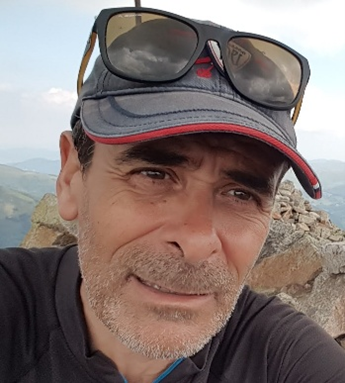
Patrice Baby
Patrice Baby
Patrice Baby is a geologist, Research Director at the “Institut de Recherche pour le Développement” in the Lab. GET of Toulouse (UMR 5563), and Guest Professor at the “Pontificia Universidad Catolica del Peru” (PUCP). He obtained his doctorate from “Université Paul Sabatier de Toulouse” in 1988. His PhD thesis focused on the structural architecture of the Pyrenean orogen. Since 1988, his general research interests focus on Andean geodynamics and georesources. During the last 30 years, he worked in international scientific cooperation with academic and industrial partners of Bolivia, Peru and Ecuador. From 2008 to 2011, he was Co-Director of the Géosciences Environnement Toulouse Lab. of the University of Toulouse (France). From 2016 to 2017, he was a member of the Executive Committee of the Geological Society of Peru. Since 2016, he is a member of the Scientific and Strategic Orientation Board of the Institute Carnot ISIFoR (Institute for the Sustainable engineering of Fossil Resources). He supervised 15 PhD, and teaches geology in the PUCP. In the last few years, his research focuses on the interactions between petroleum and mineral systems. He is also involved with the PUCP in training projects on sustainable mining. He has authored or co-authored over 120 research papers in international journals and book sections.
Partners