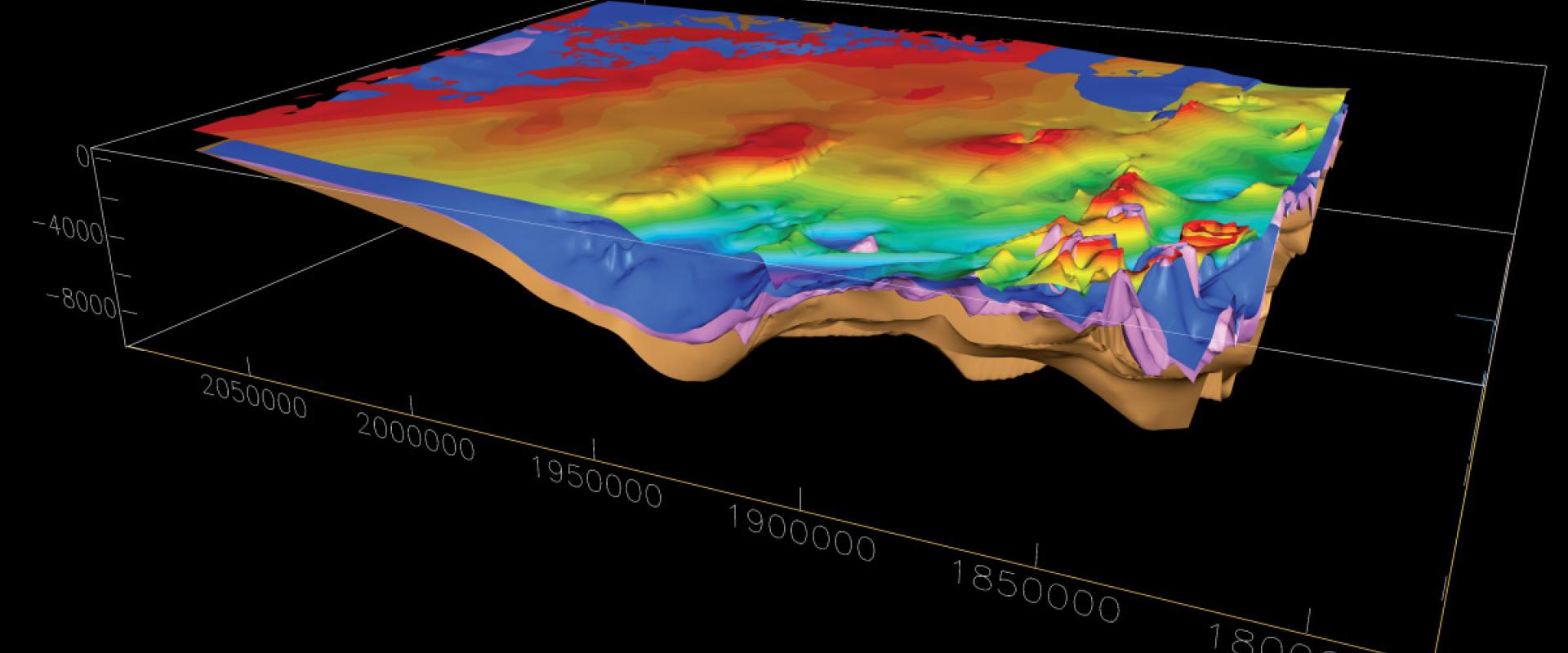
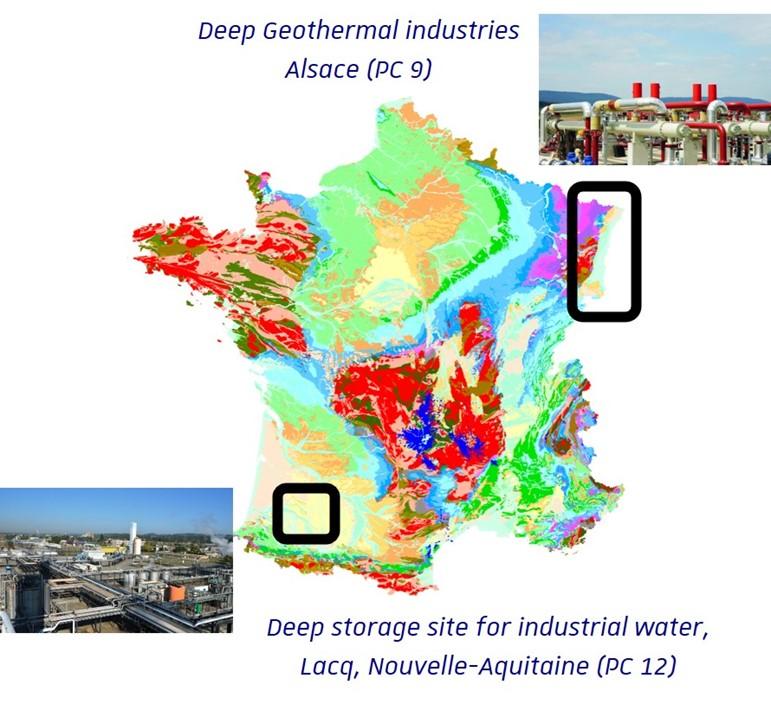
REINFORCE project study sites, already associated with two other projects in the program.
REINFORCE
Project background and objectives
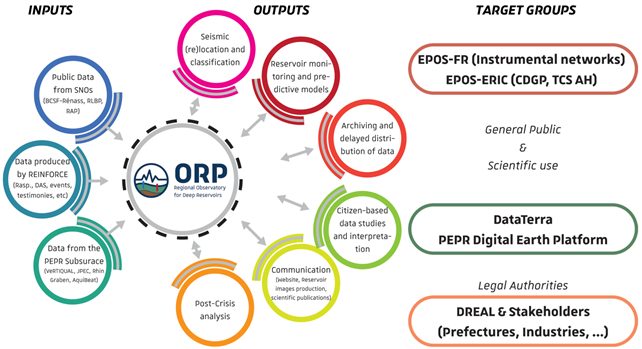
As part of the ORP project (Deep Reservoir Observatory)—developed by EOST and extended to OMP (Observatoire Midi-Pyrénées, Toulouse, France)—, the REINFORCE project will serve as a cornerstone for enhancing our understanding of deep subsurface systems. The ORP aims to establish a long-term, interoperable observation service focused on deep geological reservoirs, addressing key scientific and societal challenges outlined in the Subsurface prorgam framework.
REINFORCE will support the ORP’s broader goal of advancing resilient, inclusive, and adaptive monitoring infrastructures for the evolving energy and environmental landscape. REINFORCE will combine multi-sensor instrumentation (seismic, geodetic and DAS) with advanced data integration to monitor the behavior of deep reservoirs subjected to natural processes or industrial activities such as fluid injection, storage, and geothermal exploitation.
The project will produce real-time, open-access data products including Shakemaps and 3D subsurface visualizations, connected to emerging digital twin platforms to support scenario modeling, stakeholder communication, and risk mitigation strategies. Although international initiatives such as EPOS-ERIC, DEEP or SHEER have made significant progress in reservoir-scale monitoring, there is currently no integrated French infrastructure providing open, cross-sector, and multidisciplinary real-time data of deep reservoirs. REINFORCE fills this gap by coupling robust field data with explainable AI for signal interpretation and citizen-facing tools, offering a model for collaborative and transparent environmental science.
The project is based on two sites that are perfectly suited to the scientific and technical challenges outlined: the Rhine Graben geothermal exploitation (Soultz-Sous-Forêt, Rittershoffen, Strasbourg) and the Lacq deep reservoir, located in the southwestern region of France (Pyrénées-Atlantiques), one of the country's most emblematic subsurface sites due to its long industrial history and unique geological characteristics.
By leveraging national data infrastructures including DataTerra, Epos-France, and SNO’s such as the BCSF-Rénass, REINFORCE will ensure that data is FAIR (Findable, Accessible, Interoperable, Reusable), scalable, and aligned with ORP’s missions to strengthen the link between scientific research, public engagement, and decision-making. It will ultimately contribute to a more informed, participatory, and resilient approach to managing subsurface environments in the context of the energy transition.
Expected outcomes
REINFORCE
Expected outcomes
REINFORCE will deliver a robust, interdisciplinary framework and structure to support the responsible use and monitoring of subsurface resources, with a particular focus on urban and industrial environments undergoing geothermal exploration. By fostering active collaboration between seismologists, engineers, legal experts, social scientists, and local stakeholders—including Strasbourg Eurometropole, Grenoble, and Toulouse (together representing over 2 million inhabitants)—the project will demonstrate the scientific and societal value of DSSN citizen-operated and low-cost sensors.
REINFORCE will strengthen the link between fundamental research, innovation, and policy by developing novel methodologies in seismic signal processing, imaging, risk assessment, AI-based classification, and decision support tools. The project will also address legal and societal aspects of induced seismicity and subsurface exploitation, ensuring that the tools and knowledge produced are directly applicable to real-world governance and planning frameworks.
Through its postdoctoral training program, REINFORCE will build a new generation of experts equipped to navigate the academic, industrial, and policy-making landscapes. These young researchers will be trained in a transdisciplinary context, gaining hands-on experience with cutting- edge monitoring technologies, data science, and stakeholder engagement. This will significantly enhance their employability and position the REINFORCE project as a national reference in subsurface monitoring, risk mitigation, and public participation in science.
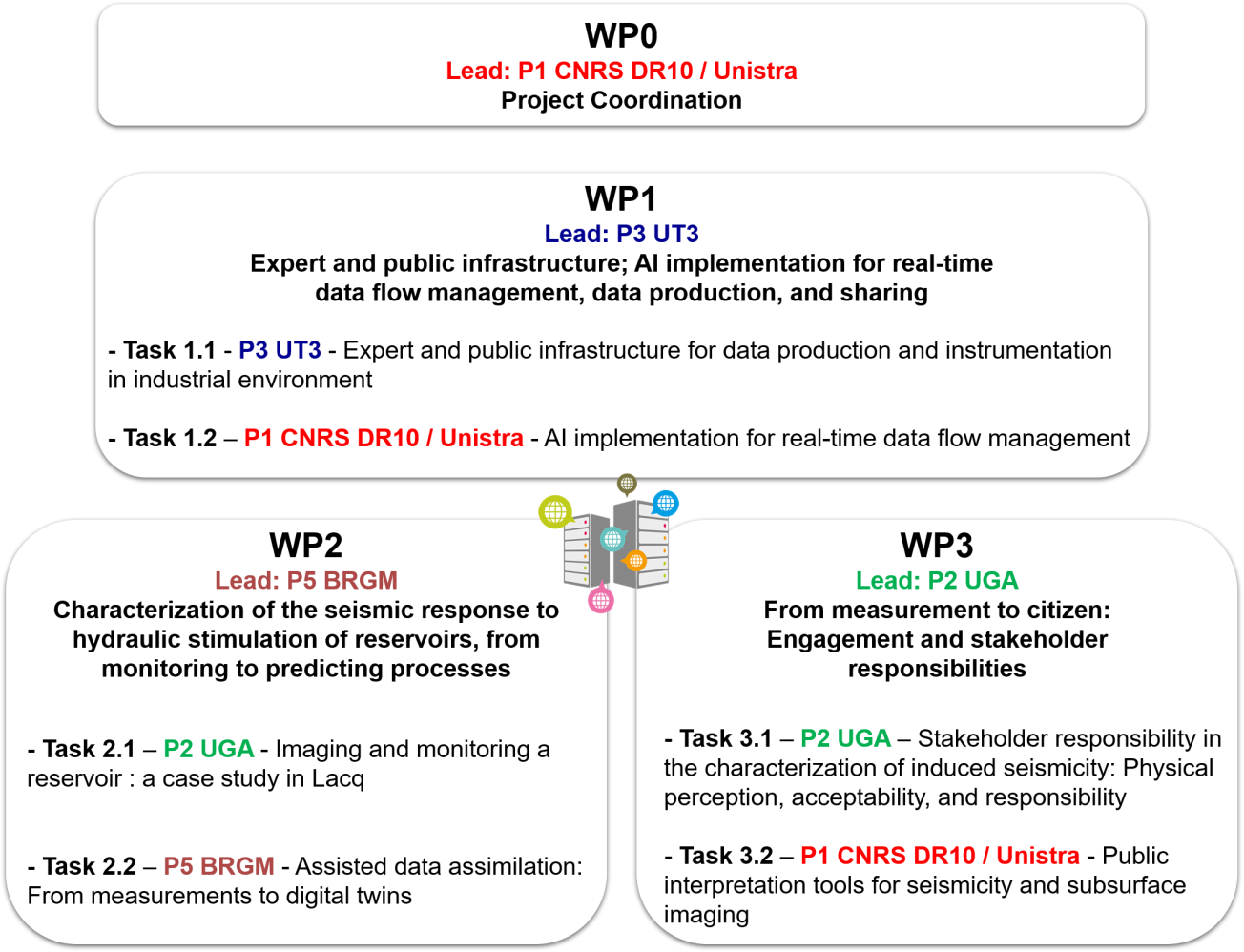
Project organization
Project leader
Benoit Derode (Université de Strasbourg), REINFORCE project leader
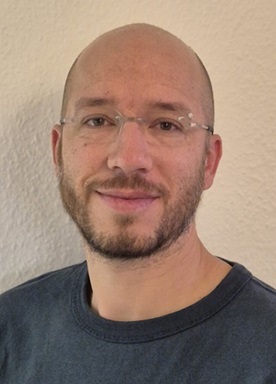
Benoit Derode
Benoit Derode
Benoit Derode is a CNAP adjunct physicist affiliated with the SNO BCSF-Rénass and conducts his research and observatory activities at the University of Strasbourg (EOST/ITES – School and Observatory of Earth Sciences / Strasbourg Earth and Environmental Institute). His interdisciplinary research combines seismology, geomechanics, and the physics of heterogeneous media. He has developed innovative laboratory experiments, multi-scale numerical modeling approaches, and carries out field-based seismological and geophysical observations. His research primarily focuses on the relationships between geological fault deformation and fluid-induced seismicity, as well as on seismic sources and wave propagation in fractured media. His work has applications in the study of earthquake initiation processes, mechanisms of induced seismicity, and the development of artificial-intelligence-based methods for seismic detection and characterization.
A recipient of the American Rock Mechanics Association Award in 2014 for an outstanding and original contribution advancing the theoretical and fundamental aspects of rock mechanics and rock engineering, and the lead investigator of the Chilean IDEC project from 2015 to 2019, he is currently involved in numerous national and European ANR projects. He is currently head of the Deep Geothermal Data Center (CDGP), the French node of the EPOS TCS Anthropogenic Hazard infrastructure, and is particularly involved in projects dedicated to geothermal energy and to fostering synergies between industry, local authorities, academia, and the general public. He is also co-head of the EPOS-France Cross-Cutting Coordination Action.
Partners