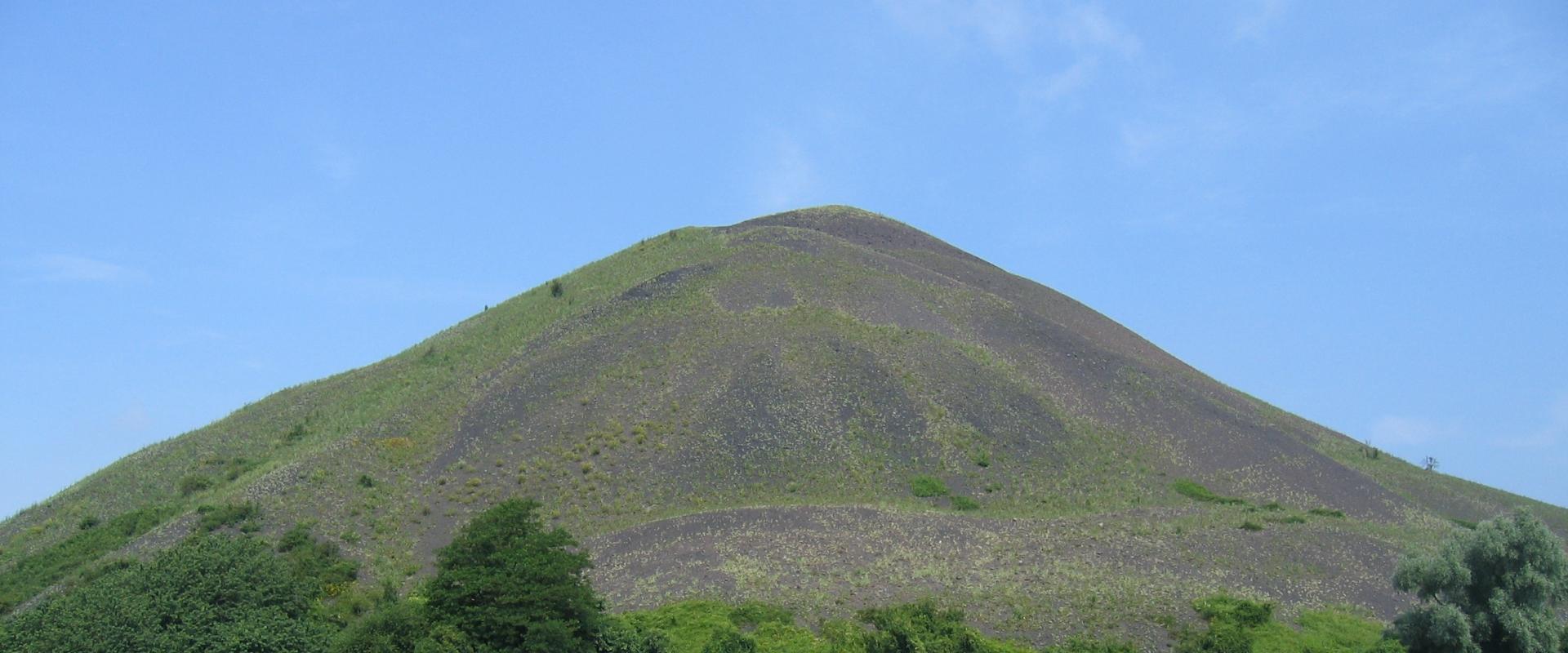
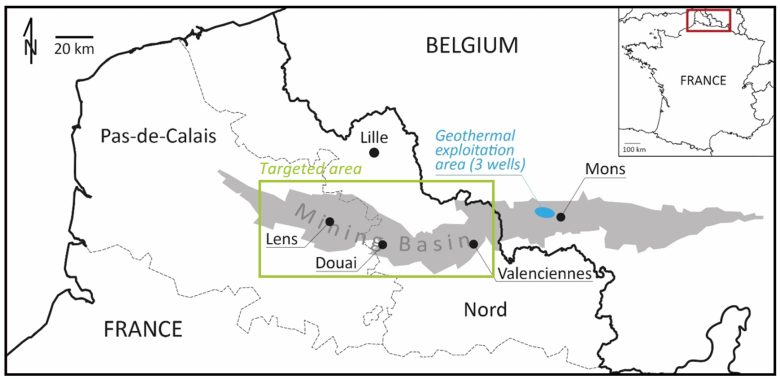
Location of the former mining basin on both sides of the France-Belgium border, and of the targeted area
GEOTHERBAMINE
Project background and objectives
The "Subsurface: a common good" research program aims to assess the potential of the French subsurface in terms of resources, particularly to meet the growing demand for decarbonized and renewable energies. Among these, deep geothermal energy is the only one capable of providing renewable heat and cold to meet the needs of industry and communities.
Geothermal projects are multiplying in geologically known and low-complexity regions such as sedimentary basins or fractured basement. But to succeed in the ongoing energy transition, this opportunity must be opened to all industrial basins and urban living basins, even if the local geosystem is complex and the economic risk of exploration is higher.
To contribute to reducing this risk and accelerating exploration, the GEOTHERBAMINE project (GEOTHERmie dans le BAssin MINier) aims to constrain a complex geothermal system directly below a highly deformed sedimentary basin, which is also a dense living and industrial basin: the former Nord Pas-de-Calais mining basin (France).
Although this region is one of those where geothermal potential is least explored, hot fluid circulation are identified above the former coal basin. This potential has led our Belgian neighbors to drill geothermal production wells in the Mons region, with results still satisfactory 40 years after the start of operation.
At the regional scale, however, the temperature of deep waters is heterogeneous. Two deep aquifers (at ~2-4 km) are potential targets for geothermal development in Nord Pas-de-Calais: the brecciated/karstic limestones of the Visean (347-331 Ma) and the limestones of the Givetian-Frasnian (390-372 Ma). These aquifers are buried under thick Carboniferous shale and sandstone units - exploited for coal for three centuries - which formed in a foreland basin along the northern thrust front of the Variscan orogenic belt. All of this forms a structurally complex zone, whose geological history must be known in detail to assess its current geothermal potential.
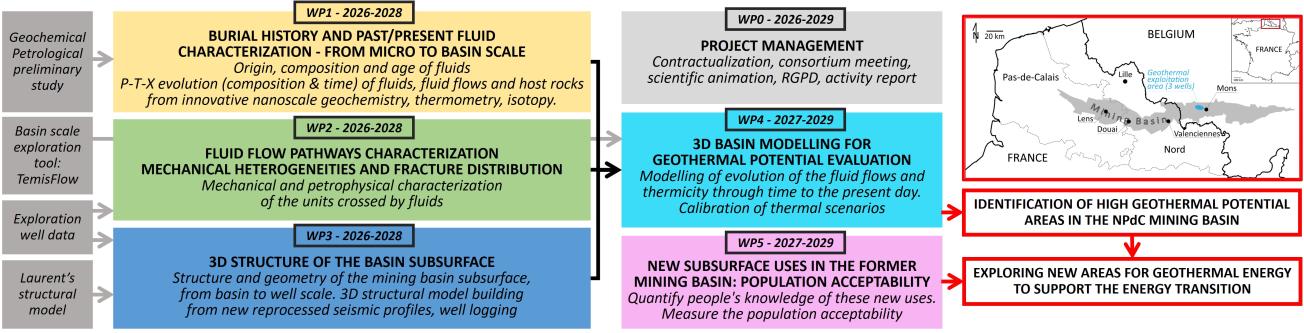
The GEOTHERBAMINE project aims to assess the geothermal potential of the structurally complex Nord-Pas-de-Calais mining basin by developing a new multi-scale 3D geomodel. It aims for four ambitious objectives through a multidisciplinary and integrated approach:
- Understand fluid flows through the basin and its substratum, and their evolution over time, by studying reservoir rocks, overlying units, and fluids (composition and origin) using petrological, geochemical, petrophysical analyses, as well as thermometric and isotopic methods.
- Reassess the 3D structure of the mining basin and the geometry of the geothermal system, by updating the recent 3D structural model developed by our team and focusing on poorly constrained zones. This involves reprocessing existing seismic profiles, their interpretation and time-depth conversion, calibrated by well logs and data from mining exploration archives.
- Model fluid circulation and thermicity in the revised 3D structural model. This requires the integration of geochemical and petrophysical data from rocks and fluids throughout geological time in a well-defined structural model, as well as testing several scenarios of system evolution.
- Identify zones of the former mining basin where the geothermal resource is most favorable for exploitation. This last point must consider socio-economic issues. This is why GEOTHERBAMINE will also study the acceptability of geothermal energy exploitation by the local population, marked by a particular relationship to risk due to past mining disasters.
Expected outcomes
The industrial history of the Hauts-de-France region has long been linked to the extraction of energy resources, particularly coal. While the end of mining exploitation resulted in socio-economic challenges, the region is now in full transition toward new energies. It now hosts France's largest nuclear power plant (Gravelines), the country's largest wind farm, as well as a new gigafactory for electric vehicle batteries (Dunkerque). Given the success of geothermal energy on the other side of the border in Belgium, similar development on the French side proves essential, an objective to which the GEOTHERBAMINE project directly contributes.
With this in mind, the major expected result is a multi-scale 3D model of current thermicity and fluid flows in the basin and its substratum, in order to guide future geothermal drilling. Expected results include:
- a detailed characterization of the physical and mechanical properties of Carboniferous units (reservoir and cover);
- an updated 3D structural mapping, from basin scale to well scale, integrating fracture zones;
- a reconstruction of the chronology of major fluid circulation events related to tectonic evolution;
- the identification of mineralogical transformations associated with fluid circulations;
- an assessment of the thermal regime of the basin and its evolution to understand the flow, circulation, and recharge dynamics of the system.
Numerous communication and knowledge dissemination actions will moreover be conducted throughout the GEOTHERBAMINE project, whether to the scientific community (researchers and students) or the general public (publications, conferences...).
Project organization
Scientific presentation
Project leaders
Franck Bourdelle (CY Cergy Paris Université)
Franck Bourdelle
Franck Bourdelle
Franck Bourdelle, Professor at the Institute of Earth Sciences of Paris (ISTeP, UMR7193) at CY Cergy Paris University, studies fluid–rock interactions involving or forming clay minerals. He specializes in the crystallochemical characterization of these minerals at small scales in order to infer their formation conditions (fluid composition, chemistry, pressure, and temperature). He applies his geochemical and thermometric tools to the study of reservoirs—particularly geothermal ones—and to anthropogenic geosystems. He is the coordinator of the GEOTHERBAMINE project, the ISTeP scientific lead for the project, and co-leader of Work Packages 1 and 5.
Olivier Averbuch (Université de Lille)
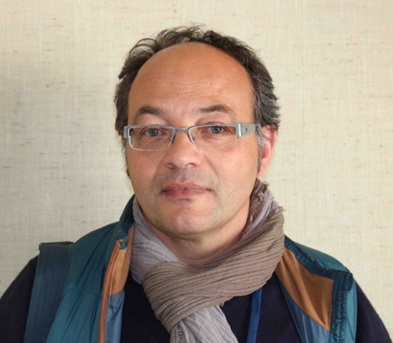
Olivier Averbuch
Olivier Averbuch
Olivier Averbuch, Assistant-Professor HDR at the Laboratory of Oceanology and Geosciences (UMR 8187) at the University of Lille is a structural geologist, specialist of deformations within orogenic systems and of dynamics of associated sedimentary basins. In the frame of the GEOTHERBAMINE project, he is co-coordinator of works dealing on the 3D structural modeling of the northern thrust front of the Variscan orogen in Northern France aiming at the characterization of the deep geometry and of the large-scale fracture pattern of the Carboniferous limestones aquifer beneath the North-Pas de Calais coal basin. He is the LOG scientific lead for GEOTHERBAMINE and co-leader for Work Package 3.
Laurent Beccaletto (BRGM)
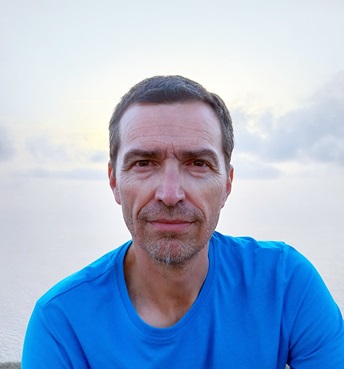
Laurent Beccaletto
Laurent Beccaletto
Laurent Beccaletto, Dr HDR, is a senior geologist at BRGM, expert in the study of sedimentary basins using borehole and seismic reflection data. His research focuses on Carboniferous-Permian basins in outcrop and subsurface. He is the BRGM scientific lead for GEOTHERBAMINE and co-leader for Work Package 3, dedicated to understanding the 3D geometry of the mining basin and its carbonate basement, the geothermal target of GEOTHERBAMINE.
Cyril Durand (Université de Lille)
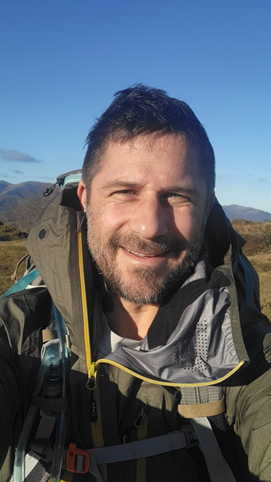
Cyril Durand
Cyril Durand
Cyril Durand is a specialist in the petrology and geochemistry of igneous and metamorphic rocks, particularly carbonate rocks. He is the director of the Master's program “Georesources, Georisks, Geotechnics”, (Engineering Geology specialization – Master 3G GEOLIN) which offers a specialization in geothermal energy. He is the LGCgE scientific lead for GEOTHERBAMINE, and co-leader for Work Packages 1 and 5.
Adriana Traby (IFPEN)
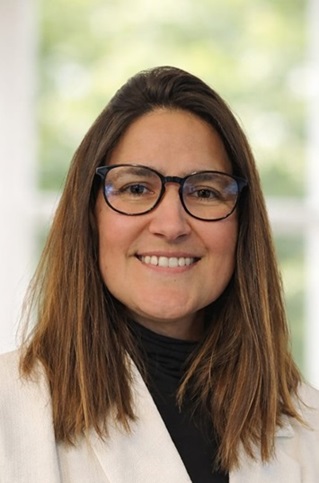
Adriana Traby
Adriana Traby
Adriana Traby is a Regional-Scale Geological Modelling R&D Project Manager at IFPEN, with 20 years of experience in basin modelling and petroleum systems analysis, applying and adapting basin modelling tools for energy transition applications including geothermal energy, lithium, hydrogen systems, and CO₂ geological storage. She is the IFPEN scientific lead for the GEOTHERBAMINE project and leads Work Package 4.
Partners