Project background and objectives
The "Armorican Mineral Systems" (ArMinSyx) project aims to improve our understanding of the mineral resource potential of the Armorican Massif through critical periods and spatial scales, selected for their prospectivity, historical importance, and knowledge gaps.
Compared to other Variscan massifs in Europe, the Armorican Massif is characterized by the presence of a Cadomian orogenic segment weakly remobilized by the Variscan orogeny. In the Léon and southern domains, the Armorican Massif is strongly affected by the Variscan orogen, with high-grade metamorphic nappes and partial melting. The Armorican Massif also records the rifting and Mesozoic and Cenozoic deformations of the Alpine cycle. Having preserved evidence of three Wilson cycles, this massif is an excellent candidate for studying metal recycling and fertility processes. However, current metallogenic models are incomplete and insufficient to guide exploration. Their study will be based on the "Mineral System" concept, which allows metal favorability to be approached through multiple entries and at multiple scales.
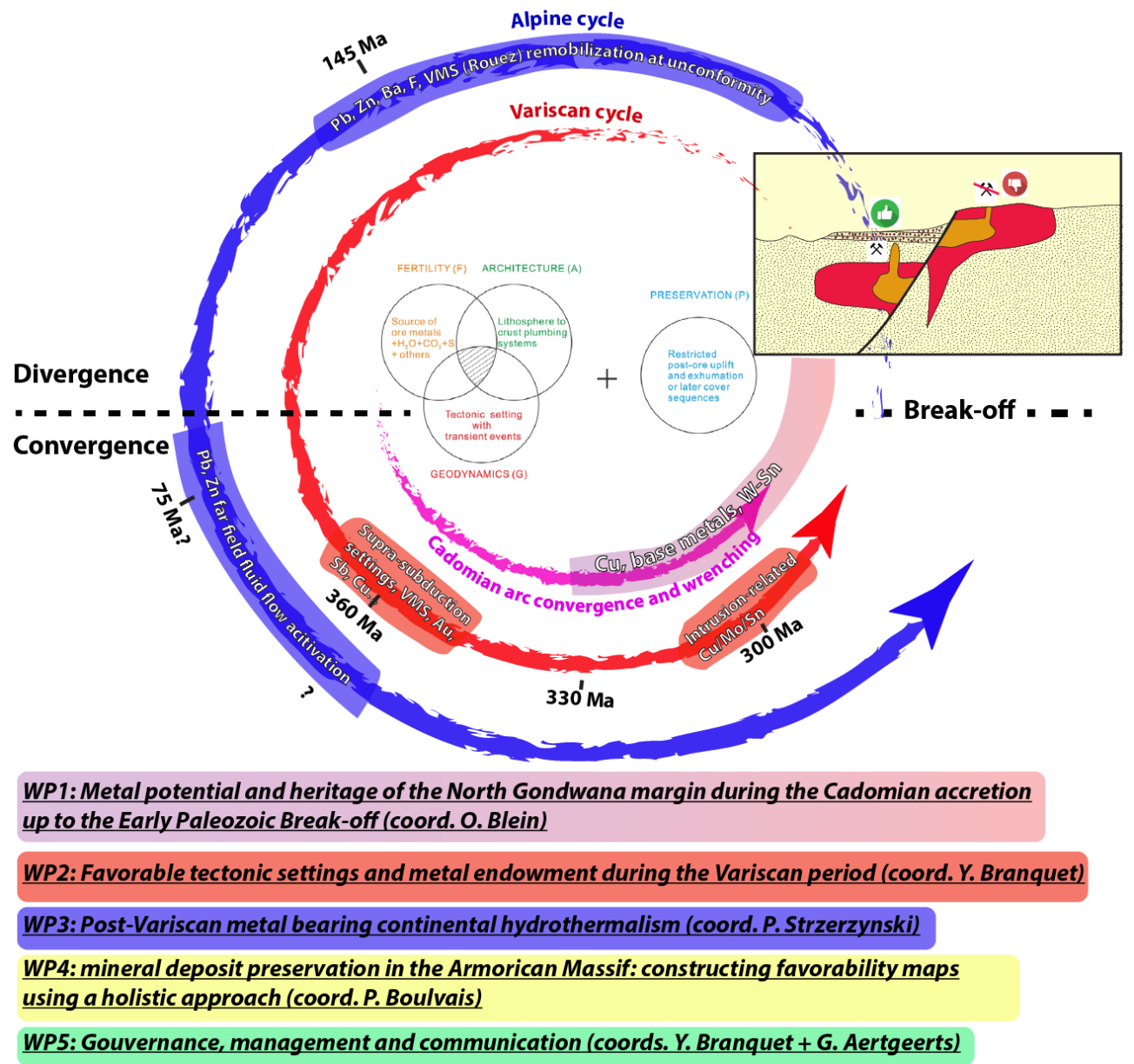
The consortium has selected 4 main questions/objectives related to metal potential, distributed across 4 work axes:
Assessment of the reality of metal potential as well as the fertility of sediments and partial melts pre-Rheic rifting of the North Gondwanian margin.
- Task 1 is dedicated to the reconstruction of the Cadomian geodynamic framework.
- Task 2 is dedicated to tracing the mobilities of incompatible elements and metals during metamorphism and the different magmatisms recorded in the Cadomian block.
Characterization of favorable tectonic contexts and their metalliferous concentrations over the Variscan period.
- Task 1 focuses on the supra-subduction context around 360 Ma.
- Task 2 aims to develop a metallogenic model of several "intrusion-related" systems rich in Cu and with unknown potential.
Study of post-Variscan continental hydrothermalism of Pb-Zn-Ba-F (Lead-Zinc-Barium-Fluorine) mineralizations.
- Two study sites:
- Along the unconformity of the Paris Basin from Poitou to Normandy;
- Dating of the large vein deposits of Pb-Zn of the Armorican Massif age.
Study and quantification of the preservation of Variscan and Cadomian deposits in order to produce favorability maps of metallic potential.
Expected outcomes
Assessment of the reality of metal potential as well as the fertility of sediments and partial melts pre-Rheic rifting of the North Gondwanian margin.
- The expected results for task 1 are constraints on:
- the position of Armorica within Gondwana;
- the position of Avalon relative to Gondwana and Armorica;
- the spatial extent of late Ediacaran magmatism, magmatism that may have played a central role in the fertilization of the continental lithosphere.
- Within the framework of task 2, the source characteristics and metallic fertility of the Upper Cadomian orogenic crust will be characterized from the petrological, geochemical, and geochronological study of different zones of the Armorican Massif representing different structural levels.
Characterization of favorable tectonic contexts and their metalliferous concentrations over the Variscan period.
- The expected results for task 1 are:
- a thermal and metamorphic evolution induced by the subduction of the northern edge of Armorica;
- a 3D thermo-mechanical supra-subduction modeling of the unthickened Armorican upper plate;
- a reexamination of Armorican VMS deposits and metallic mobilities in the Early Carboniferous in light of the Morvan and Brévennes targets of the IRM.
- For task 2, the expected result is an updated model for copper deposits related to intrusions and associated critical metals in the Variscan belt, as well as a reassessment of the metallogenic potential of this region.
Study of post-Variscan continental hydrothermalism of Pb-Zn-Ba-F (Lead-Zinc-Barium-Fluorine) mineralizations.
A doctoral thesis will be devoted to Pb-Zn-Ba-F deposits hosted in the basin along the Mesozoic unconformity on the Armorican Massif, with the following tasks:
- on selected targets, petro-structural studies, the nature and origin of fluids, and dating of the metalliferous paragenesis;
- identify, in the currently outcropping basement, the sources and metallic drains: are they diffuse or localized along major alteration corridors? These questions will be addressed through petrography and mass balance analysis of elements, associated with absolute dating on promising targets;
- multi-scale hydrothermal modeling.
Study and quantification of the preservation of Variscan and Cadomian deposits in order to produce favorability maps of metallic potential.
The ambition in this axis is to produce predictive maps, independent and therefore complementary to those produced using statistical techniques (i.e., cost-benefit analysis in BRGM reports). Given the diversity of approaches, techniques, and data to be processed and integrated, this holistic integration work requires the participation of a postdoctoral researcher for 24 months.
Project organization
Scientific presentation
Partners