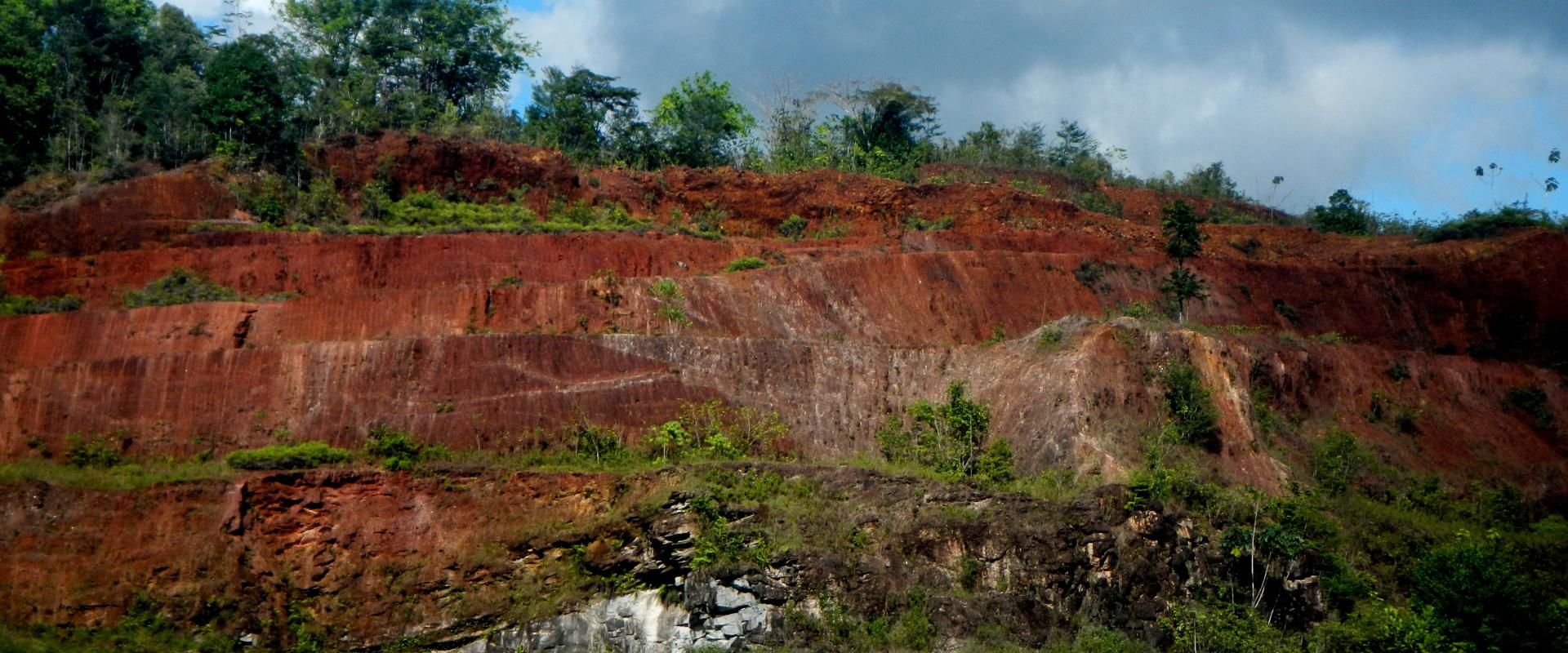
Located in the northeastern part of the South American continent, French Guiana is the second largest French department (84,000 km2) and is 94% covered by equatorial forest, harboring very rich biodiversity. Although the population of this territory has the lowest density of French territories, its growth rate is one of the highest. It is primarily grouped on the coast, with much of the interior only accessible by air or river.
These sociological and geographical characteristics generate very varied representations of the subsurface and make the development of uses co-constructed with the territory's populations more complex, even though subsurface-related activities are a sensitive subject in Guiana given the wealth of its resources, its fragility and the multiple services it provides.
The specific needs of a territory
Although the Guianese territory's subsurface is recognized for its wealth in certain minerals, the geology of this territory remains largely unknown. Certain specificities of this territory (dense forest cover, exceptional and fragile biodiversity, cultural mosaic, economic fragility) tend to exacerbate the issues associated with subsurface resource exploration and use activities.
While this territory concentrates France's main legal mining activities, it remains rather poorly endowed with diversified industrial activities. The mining industry could therefore represent the only economically viable industry model and the subsurface could be seen as a simple resource perceived through an economic prism. This is not without influence on the evolution of illegal activities and gold panning in particular, which is predominant in the negative impacts of Guianese subsurface exploitation.
The presence of intermediaries facilitating perspective-taking and relations between all groups involved in subsurface-related activities thus appears to be an appropriate approach to prevent antagonistic positions between representatives of the multiple uses and services provided by the subsurface.
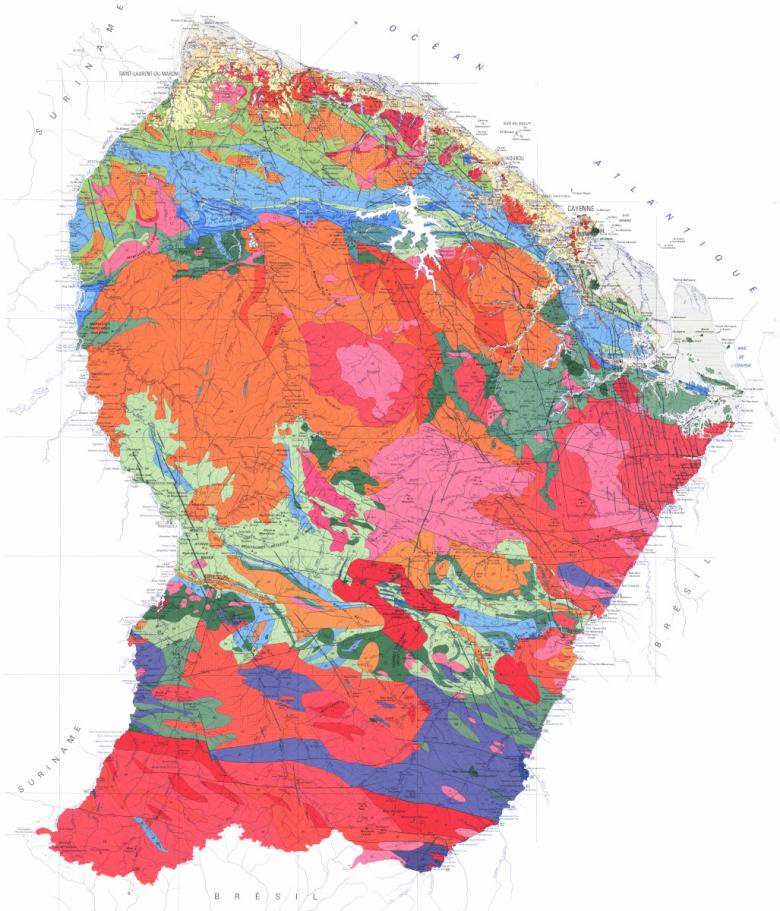
Carte géologique de la Guyane (France).
© BRGM
The subsurface, a common good to be constructed
To go beyond and enrich a relationship to the subsurface focused on extraction of its mineral resources, the GOYAVES project will work on 4 themes:
- Updating knowledge on the subsurface, ecosystems and human occupation of the entire territory.
- Uses and representations of the subsurface through territorial and social issues and via the concept of "geodiversity".
- Co-construction, between scientists and populations, of development trajectories for the enhancement or protection of the subsurface compatible with local issues.
- Preservation of relationships brought to light between the subsurface and its social ecosystems.
To this end, the GOYAVES project has already identified several pilot sites that bring together or confront different issues between the subsurface and the societies attached to it. Among these sites, a wide range of relationships can be finely analyzed to reveal the most relevant mechanisms for establishing a co-construction dynamic and achieving a common vision of the subsurface as a common good.
Examples of confronting issues related to identified pilot sites:
- Cayenne Island: geo-heritage interest, pressure from urban expansion, natural hazards (landslides).
- Cacao-Boulanger: Hmong agriculture, legal and illegal gold mines, already ongoing studies on pedology and mercury.
- Saint-Laurent-du-Maroni: geological and pedological interest, strong demographic pressure, connection with the aborted Montagne d'Or project.
Databases to create or update
Current geological maps of the Guianese territory represent the state of knowledge up to the early 2000s. They no longer correspond to current issues concerning resource use and land planning.
Significant updating and harmonization work will be implemented to compile the most recent data on geological, hydrographic, geophysical and topographical levels.
Parallel to this data from physical measurements, historiographical and archival work will be conducted on geo-historical data relating to the evolution of the role attributed to the Guianese subsurface by public decision-makers, from 1850 to the present day. Analysis of this societal data (demographic, economic, sociological, ecological, historical) will make it possible to understand the evolution over time of relationships between subsurface and society in Guiana.
Functions, benefits and social uses of the subsurface
Considering the subsurface as a common good, a shared resource that must be co-managed, implies precisely knowing its characteristics as well as its integration into a much larger socio-ecological system. Through mobilization of the concept of "geodiversity", the non-living equivalent of biodiversity, it will be possible to focus on the wide range of functions that the subsurface can provide to human societies, beyond the sole supply of mineral resources.
Nevertheless, these functions can be perceived differently depending on the stakeholders considered. Several social groups may simultaneously have strong relationships to their territory's subsurface. However, each of these groups may have uses of the subsurface that may seem contradictory or conflictual, with, even within these categories of uses, potentially very old specific knowledge, which is linked to the legal or illegal nature of activities.
This complex mosaic of populations and intersecting subsurface uses will give rise to an in-depth analysis of the strategies of different subsurface users, allowing identification and categorization, for each, of their relationship to the resource, their perception of geology, and the techniques and knowledge involved. Moreover, since each group of actors deploys its own planning strategies, analytical work on the narratives used to legitimize their actions will be conducted, based on relationships between images and texts and their evolution.
This socio-geographical research work, assisted by artificial intelligence tools, will reveal common elements among all these groups of actors and develop a unique co-construction practice based on this variety of representations, to achieve a shared understanding of issues related to the use of a common space.
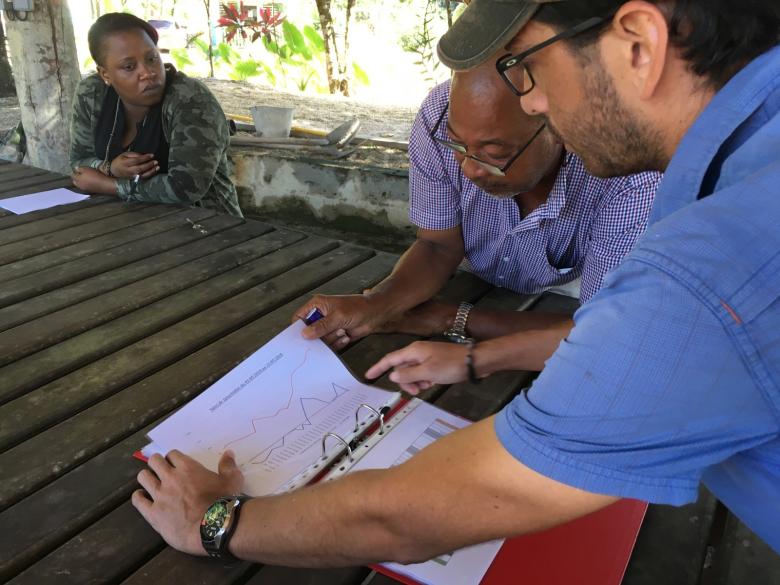
Visite de la carrière du Galion, à proximité de Cayenne (Guyane, juin 2018).
© BRGM - Bénédicte Pesset
Guianese society and its subsurface in 2040
Recognition of the key elements of each Guianese society group's relationship with its subsurface, and the history of this relationship over several centuries, will make it possible to imagine projections of its evolution in the coming decades, in light of identified needs and resources.
Prospective scenarios on possible trajectories for this relationship's evolution by 2040 will be co-constructed with representatives of involved actor groups. This scenario co-construction methodology will include different stages:
- Write the scenarios:
- Synthesis work on scientific productions and international-scale experiments as well as scenarios previously envisioned for Guiana.
- Construction with populations and computer simulations.
- Build a scenario evaluation tool in the form of serious games:
- Computer simulation work and via a board game.
- Integration of knowledge from related work.
- Deliberate on scenarios to understand the positioning of all parties involved:
- Organization of participatory workshops.
- Implementation of role-playing games allowing all parties to embody the issues and constraints of others.
A sensitive approach to the relationship between populations and their subsurface
The GOYAVES project places relationships and human societies at the center of its approach. This approach, innovative for such an object of study, tends to produce a large quantity, not only of scientific results, but also of historical documentary resources, even artistic ones about local populations, their histories and traditions.
This unique database on Guianese society will be valorized for the benefit of the local population, through preservation of research materials and results. Guianese society as a whole will be able to access the key elements that will have been identified as common factors in the relationships to the subsurface of many social groups whose relations are sometimes marked by tensions.