

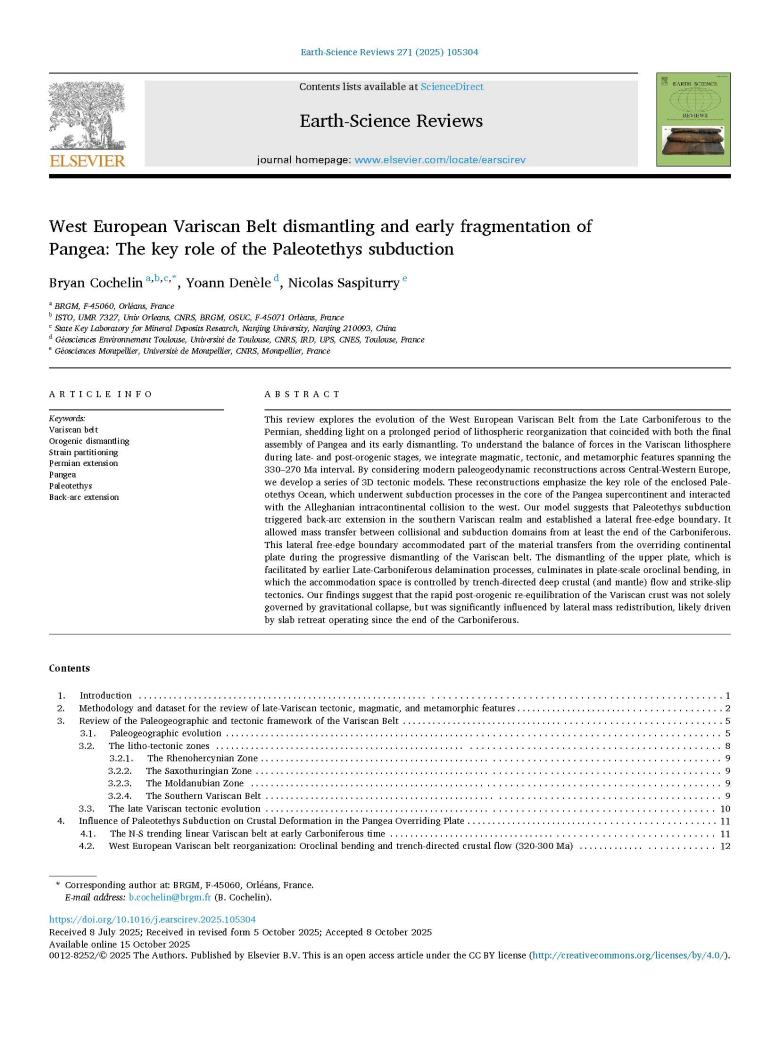
This review explores the evolution of the West European Variscan Belt from the Late Carboniferous to the Permian, shedding light on a prolonged period of lithospheric reorganization that coincided with both the final assembly of Pangea and its early dismantling. To understand the balance of forces in the Variscan lithosphere during late-and post-orogenic stages, we integrate magmatic, tectonic, and metamorphic features spanning the 330-270 Ma interval. By considering modern paleogeodynamic reconstructions across Central-Western Europe, we develop a series of 3D tectonic models. These reconstructions emphasize the key role of the enclosed Paleotethys Ocean, which underwent subduction processes in the core of the Pangea supercontinent and interacted with the Alleghanian intracontinental collision to the west. Our model suggests that Paleotethys subduction triggered back-arc extension in the southern Variscan realm and established a lateral free-edge boundary. It allowed mass transfer between collisional and subduction domains from at least the end of the Carboniferous. This lateral free-edge boundary accommodated part of the material transfers from the overriding continental plate during the progressive dismantling of the Variscan belt. The dismantling of the upper plate, which is facilitated by earlier Late-Carboniferous delamination processes, culminates in plate-scale oroclinal bending, in which the accommodation space is controlled by trench-directed deep crustal (and mantle) flow and strike-slip tectonics. Our findings suggest that the rapid post-orogenic re-equilibration of the Variscan crust was not solely governed by gravitational collapse, but was significantly influenced by lateral mass redistribution, likely driven by slab retreat operating since the end of the Carboniferous.