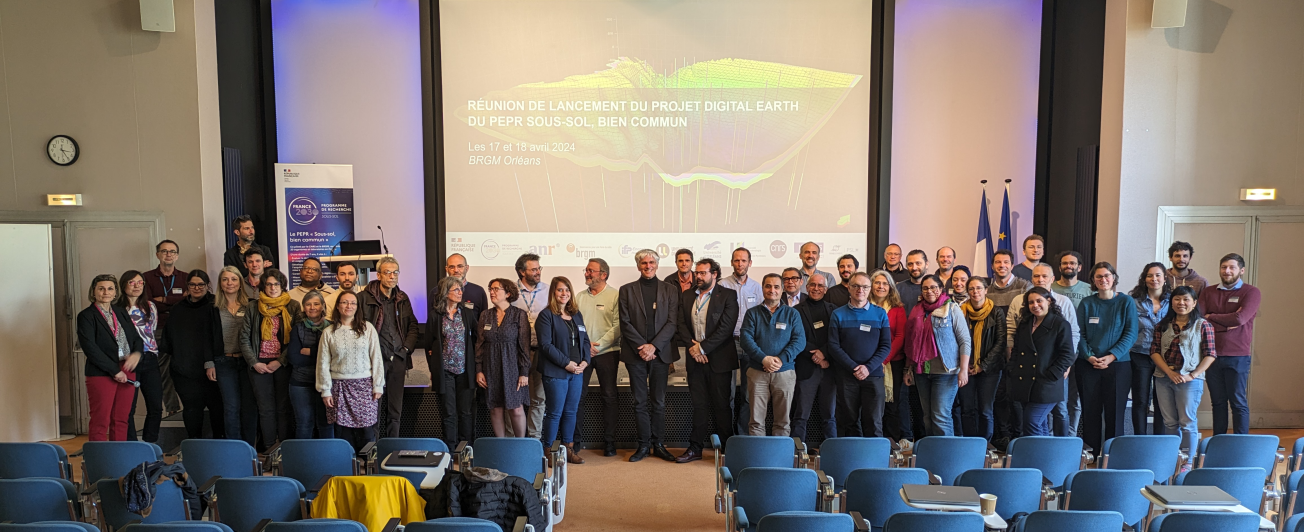
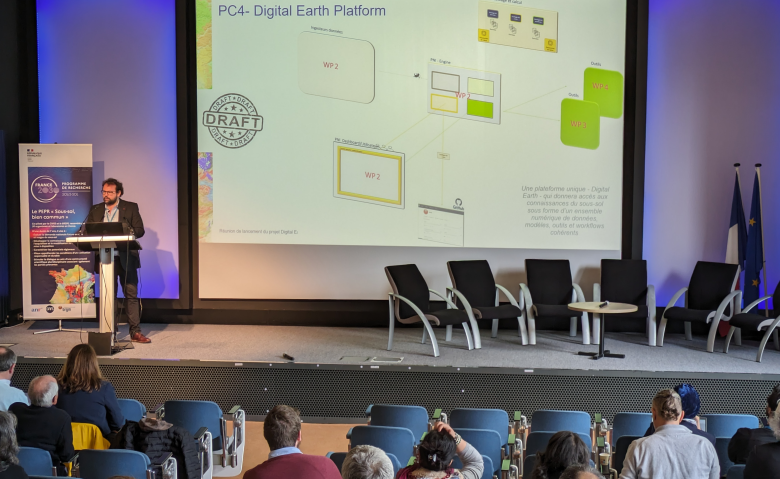
François Prognon (BRGM), coordinateur du projet Digital Earth présente la structure du projet
© PEPR Sous-sol, bien commun
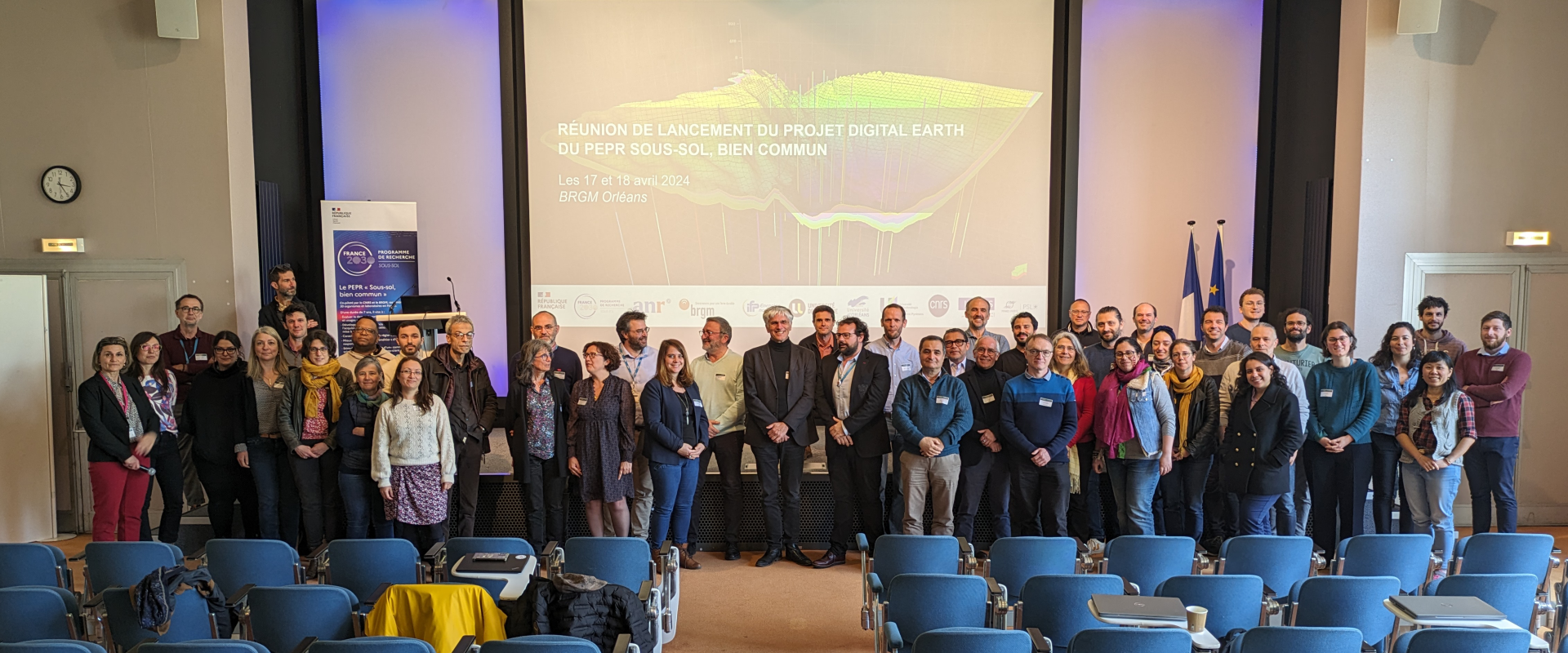
These two days aimed to bring together the Digital Earth community, allow members to get acquainted, share objectives and take stock of co-construction methods for digital services dedicated to subsurface knowledge in order to start a constructive working relationship for the next 6 years.
Developing a "Digital Earth" platform must meet numerous challenges:
- Pool practices, technologies and expertise from disciplines and scientific approaches currently compartmentalized (geology, digital, SSH) in service of geological knowledge shared by all concerned communities;
- Address complex challenges of digital revolutions with new technologies of Artificial Intelligence (AI) and Big Data, notably standardization of data acquisition protocols, workflows, tool interconnection, and processing data of difficult-to-anticipate volume.
This project is structured into 5 workpackages/poles, including a first dedicated to governance, a second constituting the project backbone and aimed at integrating actions of poles 3 to 5.
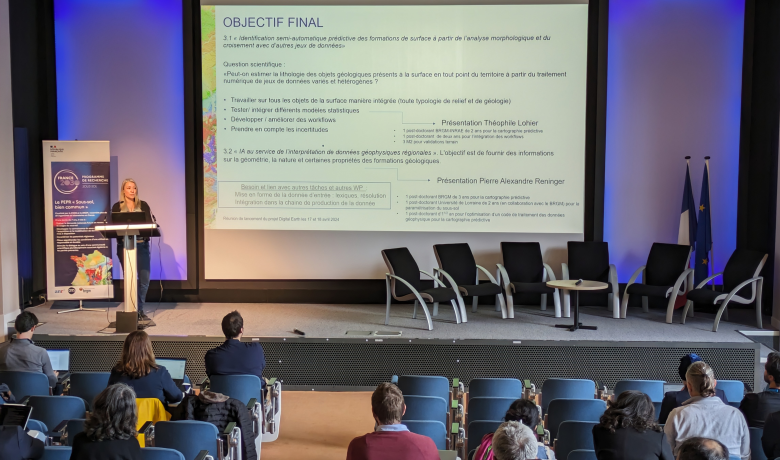
Présentation du workpackage 3.3
© PEPR Sous-sol, bien commun
AI in service of geosciences
A "Geology" pole led by Thierry Baudin (BRGM) will work to convert fundamental geological knowledge into information applicable to different subsurface uses (geothermal energy, storage, ...). It will aim to:
- Identify and understand the needs of geological knowledge producers, holders and users, via UX methods in connection with workpackage 2;
- Conceptualize a system for organizing, standardizing, managing, representing and disseminating geological knowledge, to improve collection (notably via multimodal AI), standardization and standardization of geological information;
- Improve recognition of geological objects that compose our territory by using advanced digital technologies (Big Data, AI) to cross direct observation with geophysical or remote sensing data. It particularly targets semi-automatic identification of surface formations from morphological analysis and crossing with other datasets.
Predictive models and better uncertainty quantification
A spatial prediction pole led by Guillaume Caumon (GeoRessources and ENSG, University of Lorraine) and Simon Lopez (BRGM) aims to develop new methodologies to better integrate geological concepts in the form of quantitative and predictive models through theoretical developments, modeling processes and algorithms, in order to integrate knowledge on the subsurface and quantify geological and physical uncertainties to reduce them.
It is structured around:
- New methods for 3D subsurface modeling: structural modeling based not only on data, but also on geologists' sketches to rapidly explore different geological scenarios;
- Detection and multi-scenario modeling of geological discontinuities that are faults and stratigraphic unconformities;
- Inversion of geophysical data to understand links between fracture geometry and effective elastic properties, and to integrate geometry (even existence) of geological objects into the inverse problem;
- Development of an open toolbox of geological modeling software, to make these tools available and facilitate their deployment.
Toward more precise numerical modeling of physical processes
"Numerical simulation will be essential to address challenges raised by subsurface exploitation in the context of energy transition" emphasizes Marie Christine Cacas Stenz (IFPEN), in charge of the multi-physics modeling pole.
On the one hand to characterize the deep subsurface where data is partial, notably the spatial distribution of rock nature and their petrophysical properties (useful for CCS, lithium exploration, hydrogen), temperature (geothermal energy, ...), fluid composition, or even geomechanical conditions. On the other hand, to simulate exploitation in order to dimension it and estimate associated risks.
This pole will work on more precise numerical modeling of physics, either by coupling processes (with case studies being exploration of lithium dissolved in deep brines, or hydrogen alteration in storage), or by integrating models at different scales. It also aims to improve simulation precision through the use of finer meshes, and their reliability by integrating uncertainties which requires faster calculation.
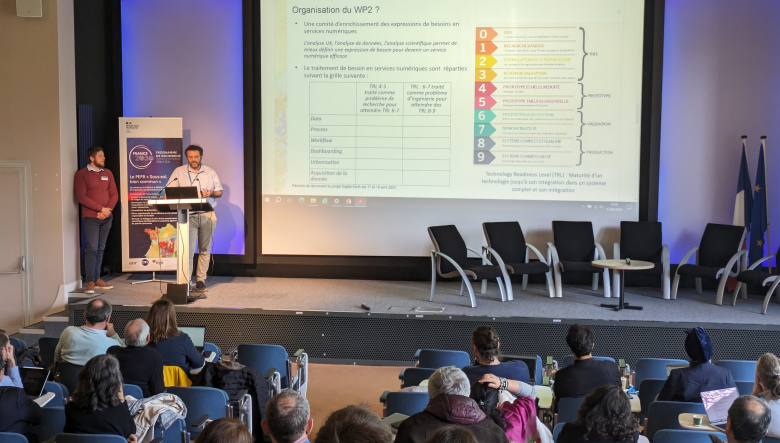
Présentation du workpackage 2
© PEPR Sous-sol, bien commun
The project backbone: a dedicated geoscientific information system to improve subsurface modeling
Finally, a pole led by Yann Dantal (BRGM) aims to increase the performance of geological studies and subsurface modeling, and to improve modeling quality in a continuous improvement logic.
This pole will first propose a concerted methodology between data experts, UX and geosciences based on "Business Process Management" technique to enrich the expression of digital service needs of other Digital Earth workpackages and other PEPR Subsurface projects, in order to process these needs.
Then the "Gateway" pole will propose developments to build expressed digital services, following two reading grids:
- The first grid classifies developments into 6 categories: data standardization, standardization and benchmarking of data access, processing and ingestion processes, workflow tools allowing process chaining, data visualization tool and methodology (Dashboarding), data urbanization and acquisition;
- The second classifies developments according to their maturity. Developments at TRL 4/5 (Presence of a functional prototype in limited or expanded version) will be the subject of research projects (Doctoral and Post-Doctoral) to reach a degree of maturation at TRL 6/7 (Prototyping or Demonstrator). Developments at TRL 6/7 will be the subject of IT engineering action (1 Tech Lead and 2 Developers) to take them to TRL 8/9 level (Complete and qualified system or commercialized system).
All developments will be supervised by an engineering team, a scientific team and a UX team to ensure quality of research and engineering IT production following a Creativity->Prototyping->Test->Modeling->Deployment support->Operation cycle.
Work workshops on standard methods for co-constructing digital services were thus set up during these days. This meeting was also an opportunity to exchange on the needs of other targeted projects of the Subsurface, Common Good PEPR, and on interactions with digital platforms of PEPRs Risks (IRiMa) and One Water, projects respectively led by Joël Langlois (BRGM) and Sylvain Grellet (BRGM).