


International Forum on Energy and Climate Law
Plateforme européenne de recherche sur le droit de l'énergie et du climat.
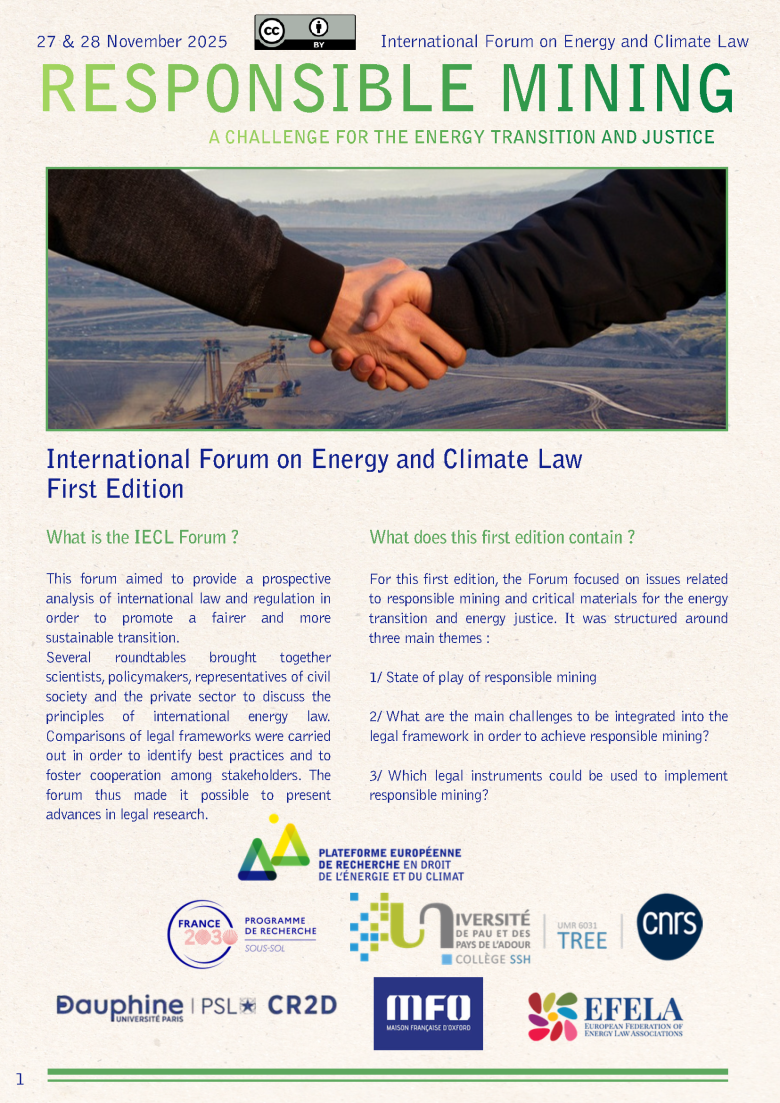
The energy transition relies on an intensified use of critical minerals: wind, solar, batteries and grids require far more of them than the technologies they replace. As one of the Forum’s findings puts it, reducing emissions does not mean reducing resource needs. This tension ran through both days of discussion, organised by the European Research Platform on Energy and Climate Law with the support of the JPEC project (Justice Pathways for Extractives and Critical Minerals) of the “Sous-sol, bien commun” programme and of the European Federation of Energy Law Associations (EFELA).
Three sessions, three questions
The first session took stock of the current situation. Speakers highlighted Europe’s dependence on globalised, highly concentrated value chains and the need to diversify supply through international cooperation. They also stressed that a mine is not limited to extraction: closure, rehabilitation and financial guarantees must be considered from the exploration phase onwards. One roundtable also addressed the legal status of the deep seabed, defined as the common heritage of humankind.
The second session focused on the challenges to be integrated into the responsible mining framework. How can security of supply be reconciled with local concerns, drawing on cases as different as artisanal mining in Ghana, where the formalisation of titles can strip women of their rights to land, and lithium and uranium projects in Spain? What role can multi-stakeholder standards such as IRMA play, giving equal governance, and a right of veto, to affected communities, industry and NGOs alike?
The third session turned to legal instruments: the EU Critical Raw Materials Regulation and its fast-track procedures, due diligence legislation, voluntary standards, local content agreements, and the planned AFNOR standard on responsible mining exploration. The common thread was the need to move beyond the opposition between binding law and soft law towards “co-regulation”, in which voluntary standards act as a testing ground before being anchored in law.
Two contributions from the JPEC project
Louis de Fontenelle, [position to be confirmed], spoke in the roundtable on the outstanding challenges still to be addressed. He pointed out that subsoil governance produces irreversible effects over timeframes far exceeding the duration of any project: the traditional social contract excludes future generations, who will nevertheless bear the consequences. Responsible mining must therefore integrate intergenerational justice more explicitly. The roundtable concluded in favour of a paradigm shift, from a logic of “conquest” to one of “stewardship” of geological resources for the benefit of present and future generations, with concrete recommendations: intergenerational impact assessments, sufficiency-based demand scenarios in permitting processes, no-mining zones, and long-term financial guarantees.
Ibrahim Khalil Sanogo, postdoctoral researcher in the JPEC project (BRGM, Université de Pau), spoke in the roundtable on legal instruments. He emphasised that the regulation of responsible mining rests on numerous, scattered and sometimes inconsistent rules, which weakens their effectiveness and creates a risk of “compliance greenwashing”, where companies merely tick boxes without any real transformation. A more credible implementation requires better articulation between binding law, voluntary standards, transparency obligations and multi-stakeholder governance, with voluntary standards acting as “innovators” that must then be anchored in law.
Read more
The report, published in English, covers the issues, legal framework and recommendations for each roundtable, and closes with seven key ideas to retain.